Building a website is just the beginning. The real challenge is continuously answering these questions: What content should I write? Which keywords are driving traffic for competitors? What technical issues are affecting rankings? Where should I get backlinks? Did the optimization actually produce growth?

Semrush consolidates keyword research, competitive analysis, technical SEO, backlink analysis, rank tracking, content optimization, and AI search visibility into one integrated toolset. This article combines Semrush's current product structure to demonstrate a complete workflow from opportunity discovery to results review in 6 operational steps.

What is Semrush

Semrush is a digital marketing and search visibility platform. Its SEO tools can research organic search, paid search, keywords, competitors, and backlinks for any website, and can also create projects for your own website to continuously perform site audits, rank tracking, and page optimization.

Two types of data in Semrush must be distinguished:

  1. Competitive Intelligence Data: Estimated through Semrush's database and models, used to research keywords, traffic, ads, and backlinks of other websites.
  2. Project Data: Continuously collected for your own website through crawlers, rank monitoring, and connecting data sources like Google Analytics 4 and Google Search Console.

The former is suitable for "watching competitors," the latter for "managing yourself." They can complement each other, but estimated values should not be treated as real numbers from competitors' backends.

Product Structure in 2026

Semrush is no longer just a monolithic SEO software, but consists of multiple toolkits including:

  • SEO Classic: Domain research, keywords, rank tracking, backlinks, and site audit;
  • Semrush One: Integrates AI search visibility on top of traditional SEO;
  • AI Visibility: Brand visibility in generative search like ChatGPT, Google AI, etc.;
  • Traffic & Market: Website traffic, market size, audience, and competitive landscape;
  • Local: Local business listings, reviews, and map rankings;
  • Content: Topic selection, writing, and content optimization;
  • Social, Advertising, AI PR: Social media, advertising, and PR tools;
  • App Center: Third-party or add-on applications.

This article focuses on the most commonly used workflows in SEO Classic, while supplementing changes in AI search and market research.

What Problems Semrush Can Solve

Research Competitors

  • How much organic search traffic competitors are getting;
  • Which keywords and pages contribute the most;
  • Where competitors perform better by country or device;
  • Which backlinks and referring domains competitors rely on;
  • Which paid keywords, ad copy, or landing pages are being used.

Develop Keyword Strategy

  • A keyword's search volume, difficulty, intent, and CPC;
  • What related terms, long-tail keywords, and question keywords exist;
  • Which keywords are suitable for articles, category pages, product pages, or tool pages;
  • Which keywords competitors rank for but you haven't covered;
  • Which keywords are close to the first page and worth prioritizing for optimization.

Maintain Site Health

  • Whether the site has crawl, index, HTTPS, duplicate content, or internal linking issues;
  • Whether titles, descriptions, H1s, image ALT tags, and canonical tags are abnormal;
  • Whether Core Web Vitals and page performance need improvement;
  • Whether site health continues to improve after fixes.

Monitor Execution Results

  • Whether target keyword rankings are rising or falling;
  • The visibility gap between yourself and competitors;
  • Performance across different countries, cities, and devices;
  • Which URLs gained or lost rankings;
  • Whether SEO efforts delivered expected traffic and market share changes.

Three Important Concepts Before Getting Started

Database and Region

Keyword search volume, difficulty, CPC, and rankings are all tied to country-specific databases. When researching China, the US, the UK, or other markets, select the corresponding database. Data from different countries cannot be directly merged or compared.

Semrush offers a Simplified Chinese interface, but "interface language" and "keyword database" are two different things. Switching the interface to Chinese does not automatically change your research scope to China.

Root Domain, Subdomain, Subfolder, and Exact URL

Domain Overview allows you to choose different analysis scopes:

  • example.com: Entire root domain;
  • blog.example.com: Specified subdomain;
  • example.com/blog/: Specified subfolder;
  • example.com/page.html: Specified page.

Use root domain when researching an entire company; use subdomains and subfolders when researching blogs, product lines, or regional sites for greater accuracy.

Search Intent

Semrush typically categorizes search intent as:

  • Informational: Users want to learn or find answers;
  • Navigational: Users want to reach a specific website or brand page;
  • Commercial: Users are comparing solutions, brands, or products;
  • Transactional: Users are ready to purchase, download, register, or take action.

Keyword strategy shouldn't only chase search volume. Page types must match search intent, otherwise even lengthy content will struggle to maintain stable rankings.

Step 1: Domain Overview and Competitive Research

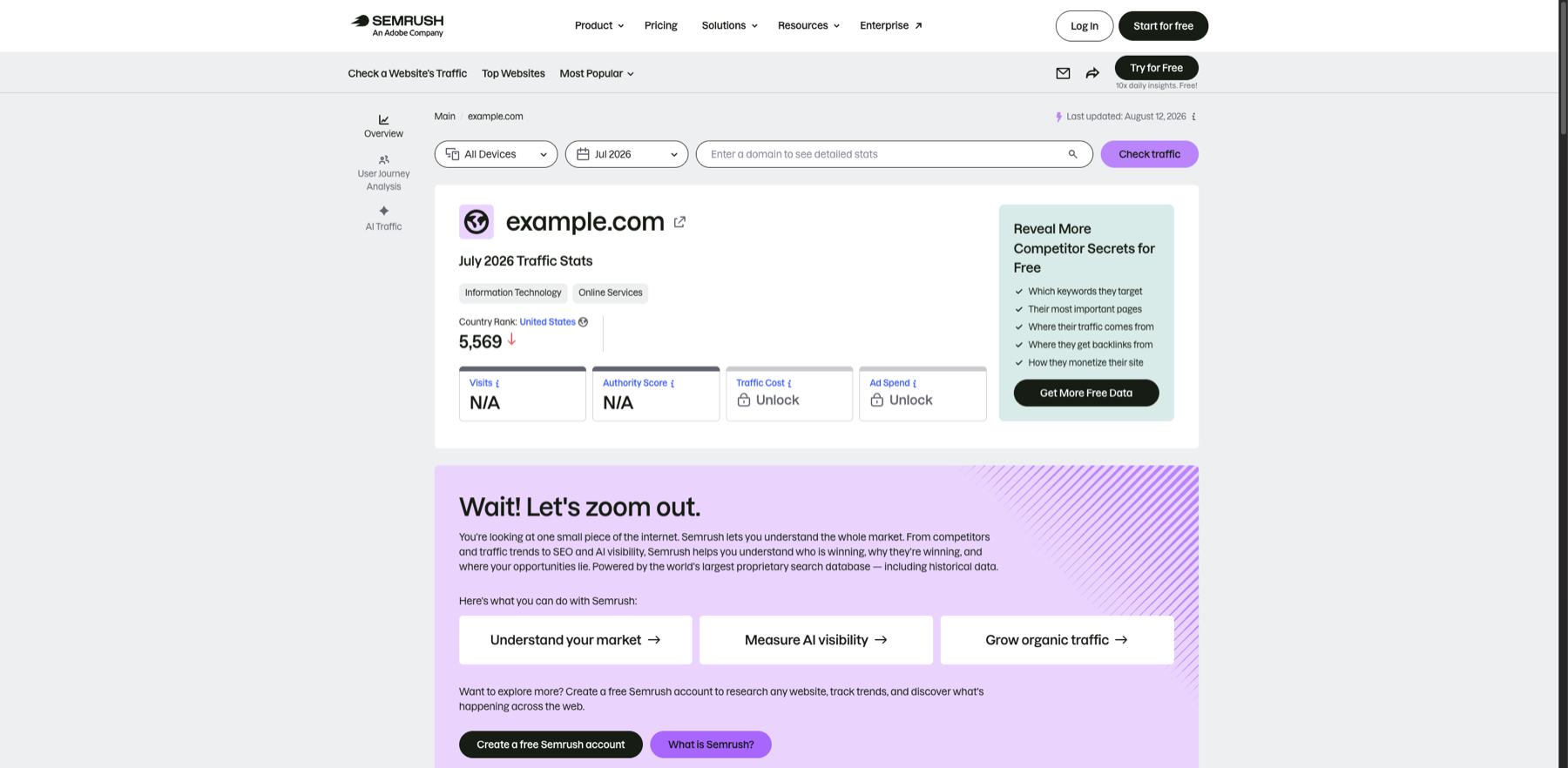
Go to SEO → Competitive Analysis → Domain Overview, enter your own or competitor's domain, and select the country database and analysis scope.

What to Look at in Domain Overview

Authority Score

This is Semrush's composite metric that summarizes a domain's link quality, organic search performance, and spam signals. It's suitable for comparing similar websites, not an official Google ranking score, and higher doesn't guarantee better rankings.

Correct usage:

  • Compare with direct competitors;
  • Observe long-term trends;
  • Evaluate potential backlink sources;
  • Detect anomalies when scores suddenly drop.

Incorrect usage: Treating Authority Score as the only KPI, or buying large quantities of low-quality links just to increase the score.

Organic Search Traffic and Keywords

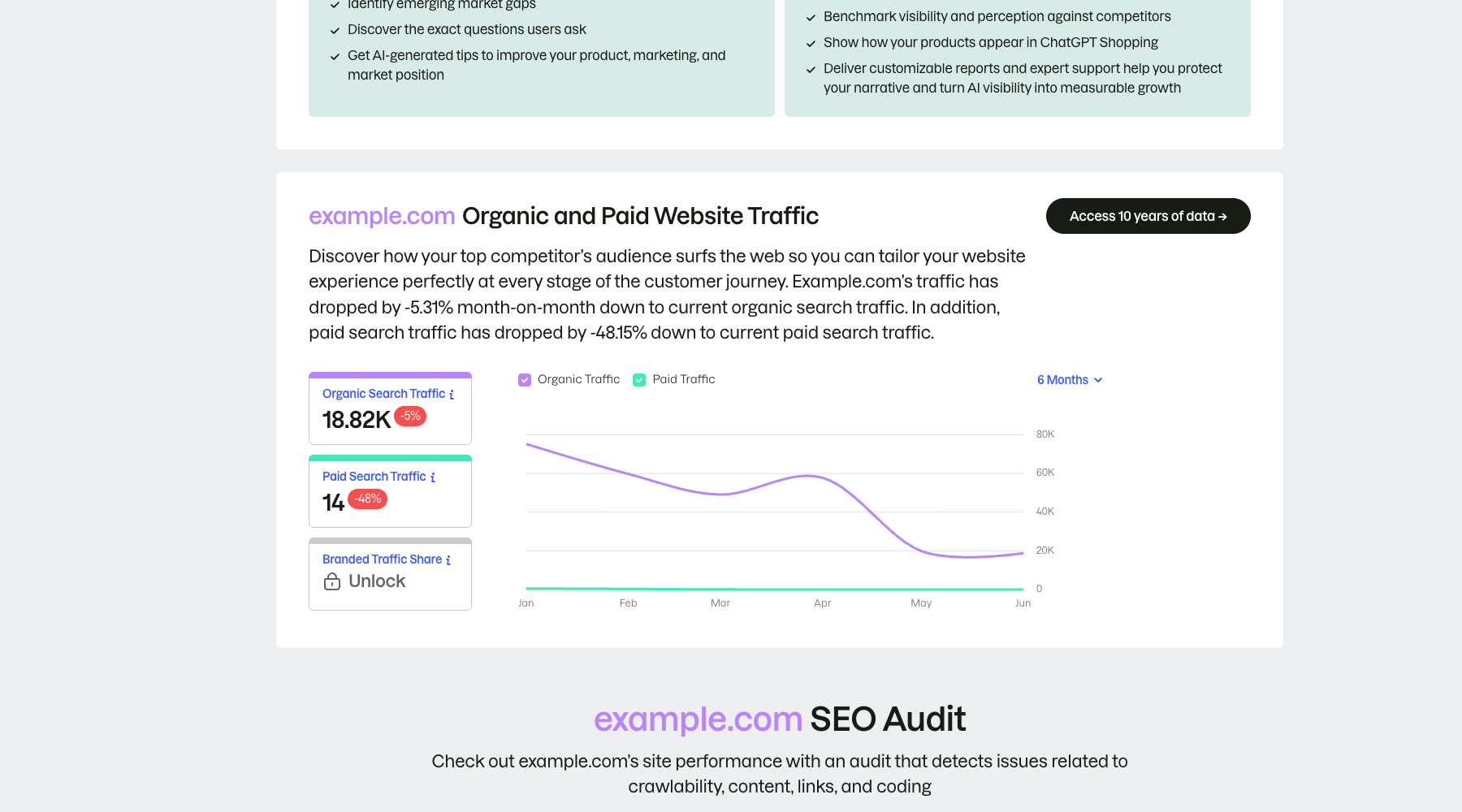
Organic search traffic is Semrush's estimated value calculated based on keyword rankings, search volume, and estimated click-through rate. Focus on:

  • Total keywords and estimated traffic trends;
  • Distribution of keywords ranking in top 3, top 10, top 20, and top 100;
  • New, rising, declining, and lost keywords;
  • Ratio of branded vs. non-branded keywords;
  • Topics and pages driving the most traffic.

If estimated traffic suddenly drops, check algorithm update dates, site migrations, page deletions, competitor content changes, and SERP feature changes.

Paid Search Traffic

This section displays paid keywords, advertising competitors, ad copy, and budget-related estimates. It's useful for discovering products competitors are heavily promoting and high commercial value keywords, but doesn't equal their actual ad backend spending.

Backlinks

Domain Overview only provides a backlink summary. When you need to assess link quality, proceed to the Backlinks and Referring Domains reports to view referring domains, anchor text, link types, and new/lost links.

AI Visibility

Semrush's current Domain Overview includes AI visibility, brand mentions, cited pages, and sources. It helps determine whether a brand appears in generative answers and which pages are cited by AI systems.

AI visibility should be analyzed separately from traditional organic search. Being mentioned by AI may not necessarily generate clicks, but can influence brand awareness and user decisions.

From Domain Overview to In-Depth Analysis

Every number in Domain Overview is an entry point. Recommended clicks in order:

  1. Organic Search Traffic → Organic Rankings;
  2. Top Keywords → View intent, rankings, and URLs;
  3. Top Pages → Analyze page types and topics;
  4. Competitors → Build a list of competing domains;
  5. Backlinks → View referring domains and anchor text;
  6. AI Visibility → View brand mentions and citation sources.

Step 2: Keyword Overview and Keyword Magic Tool

Keyword Overview

Go to Keyword Research → Keyword Overview, enter a core term, and select the database.

Core metrics in Keyword Overview include:

Metric Meaning How to Use
Search Intent Purpose behind user search Determine page type and conversion design
Monthly Search Volume Average monthly queries Judge demand scale, not achievable traffic
Global Search Volume Combined across multiple country databases For international markets, not for single-region guidance
Keyword Difficulty Competition difficulty to rank in top organic results Evaluate together with site strength
Personalized Keyword Difficulty Difficulty calculated with specified domain relevance Better than generic difficulty for prioritization
Trend Demand change over last 12 months Judge seasonality and content timing
CPC Estimated ad click price Judge commercial value and paid competition
Competitive Density Level of advertiser competition For paid search judgment

Don't Only Choose High-Volume Keywords

A high-volume keyword may be too broad, highly competitive, or irrelevant to business. Recommended four-factor scoring:

Keyword Priority = Business Relevance × Search Intent Match × Rankability × Potential Value

Search volume is just one variable. For B2B, high-value transactions, or niche markets, dozens of high-intent searches may be more valuable than tens of thousands of generic traffic.

Keyword Magic Tool

From Keyword Overview, enter Keyword Magic Tool to batch-expand related terms. Common filtering methods:

  • Broad Match: Discover larger topic scope;
  • Phrase Match: Preserve core phrase;
  • Exact Match: Research close variants;
  • Related: Find semantically related new topics;
  • Questions: Extract "what, how, why" and other content topics;
  • Intent Filter: View only informational, commercial, or transactional;
  • KD, Search Volume, CPC: Narrow by resources and commercial value;
  • Include/Exclude: Filter brand terms, location terms, or irrelevant meanings.

After filtering, add candidate keywords to Keyword Strategy Builder, then cluster by topic. Don't mechanically cover dozens of keywords with different intents on one page.

Step 3: Keyword Gap Analysis

Go to Competitive Analysis → Keyword Gap. Enter your site and up to four competitors, select organic, paid, or shopping ad keywords, then click Compare.

Five Types of Keyword Opportunities

  • Missing: Competitors rank, you have no ranking;
  • Weak: Both rank, but you rank lower;
  • Strong: You rank higher than all competitors;
  • Shared: You and competitors both rank;
  • Untapped/Unique: Opportunities that appear on only some websites.

Different interface versions may use names like "Untapped, Missing, Unique," but the core logic is always comparing keyword sets and ranking differences.

Correct Filtering Sequence

  1. Select 3–4 competitors closest to your business;
  2. Start with "Missing" and "Weaker";
  3. Add search intent filtering;
  4. Limit keyword difficulty to what your site can handle;
  5. Exclude brand terms and irrelevant topics;
  6. Check SERP to confirm page types;
  7. Add 5–10 priority keywords to your keyword list.

Official recommendation: focus on a small number of keywords initially. Exporting thousands of keywords without resources to execute is usually less valuable than a clear 10-keyword plan.

How to Decide: Create New or Optimize Existing Pages

  • No corresponding page exists: create new content;
  • Page exists but ranks 11–30: prioritize updating the existing page;
  • Multiple pages competing for the same keyword: address keyword cannibalization;
  • Search results dominated by product pages: don't force a blog post to compete;
  • Competitor pages are noticeably more comprehensive: fill gaps in topic coverage, evidence, structure, and user experience.

Step 4: Backlinks and Link Gap

Backlinks

Enter any domain to view:

  • Total backlink count;
  • Referring domains;
  • New and lost links;
  • Attributes like Follow, Nofollow, Sponsored, UGC;
  • Anchor text;
  • Referring IP and network distribution;
  • Pages with the most backlinks;
  • Similar backlink competitors.

Don't just look at total link count. Thousands of site-wide links from one domain are usually less valuable than one natural link each from multiple relevant, high-quality sites.

Backlink Gap

Go to Competitive Analysis → Backlink Gap, enter your site and competitors.

The report lists referring domains that link to competitors, filtered by opportunity type:

  • Best: Links to multiple competitors but not to you;
  • Weak: Links to you less than to competitors;
  • Strong: Links only to you;
  • Shared: Links to both you and competitors;
  • Unique: Links to only one compared site.

"Best" is usually the most worthwhile list to prioritize, because a site willing to link to multiple similar competitors has a higher probability of accepting content, resources, or partnerships from your industry.

Backlink Opportunity Evaluation Checklist

Check before outreach:

  • Topic relevance;
  • Real readership and organic traffic;
  • Authority score anomalies;
  • Sudden, suspicious backlink growth;
  • Page indexation status;
  • Natural link placement;
  • Why they would cite your content.

Actionable link building strategies include original data, free tools, industry reports, expert insights, resource page partnerships, broken link replacement, and digital PR. Don't equate "competitor has this link" with "this link is definitely safe."

Backlink Audit

This tool evaluates suspicious signals in your site's link profile. Risk labels are for filtering clues only—don't automatically submit all high-risk links to Google's Disavow tool. Incorrectly disavowing normal links can harm rankings; important actions should combine Search Console, link source analysis, and manual review.

Step 5: Site Audit

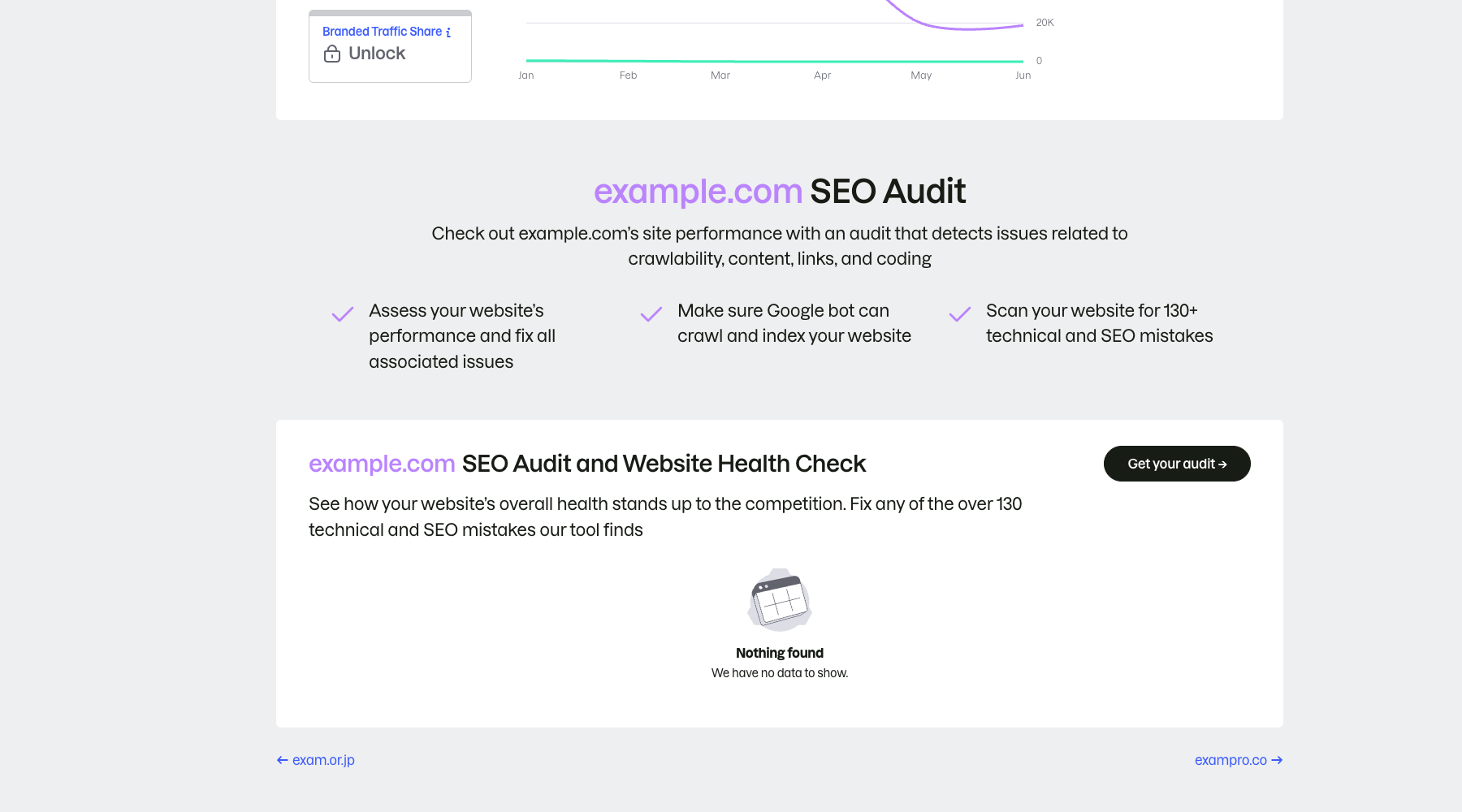
Go to Site Performance → Site Audit, create a project and set crawl scope.

Settings When Creating an Audit

  • Number of pages to crawl;
  • Start from website, Sitemap, or URL list;
  • Whether to follow robots.txt;
  • Desktop or mobile crawler;
  • Crawl speed;
  • Include or exclude specific directories;
  • Whether login credentials are needed to access staging environment.

For the first audit, it is recommended to start with a controllable number of pages. Large websites should be checked in batches by directory to avoid overly large reports.

Errors, Warnings, and Notices

  • Errors: Highest priority, may directly affect crawling, indexing, or user access;
  • Warnings: Need evaluation, usually affect quality or maintainability;
  • Notices: Optimization suggestions, not necessarily all need to be fixed.

Common issues include:

  • 4xx, 5xx status codes;
  • Redirect chains and loops;
  • Missing or duplicate titles and descriptions;
  • Abnormal H1 usage;
  • Canonical tag conflicts;
  • Sitemap and robots.txt issues;
  • Orphan pages and excessively deep internal links;
  • Missing image ALT;
  • HTTPS mixed content;
  • Page speed and Core Web Vitals.

Correct Fix Priority

Recommended processing order:

  1. Issues affecting crawling and indexing;
  2. Template issues appearing on large numbers of pages;
  3. High-traffic, high-conversion pages;
  4. Internal links and canonicalization;
  5. Content tags and image details;
  6. Low-impact notices.

Site health is an aggregate metric; do not modify content that has no business impact just to pursue a perfect score. Re-run the audit after each fix and record changes in issue count and affected pages.

Step 6: Rank Tracking

Go to Site Performance → Position Tracking, create a project, and select search engine, country, city, device, and keywords.

Most Common Setup Mistakes

  • Selecting wrong country or city;
  • Mixing desktop and mobile data;
  • Grouping brand and non-brand keywords together;
  • Adding too many irrelevant keywords at once;
  • Not adding real search competitors;
  • Only looking at rankings, not the corresponding URL.

Core Metrics

  • Visibility: Calculated based on tracked keyword rankings and estimated CTR;
  • Estimated Traffic: Estimated visits from tracked keywords;
  • Average Position: Average position of all tracked keywords;
  • Position Distribution: Count of keywords in top 3, 4—10, 11—20, 21—50, 51—100;
  • Gains/Losses: Keywords with ranking changes;
  • New/Lost: Keywords that entered or left top 100 for the first time;
  • Share of Voice: Advanced plan for measuring market visibility share.

How to Review Ranking Changes

Check for anomalies weekly, conduct formal monthly reviews:

  1. Check if overall visibility has changed;
  2. Identify keywords with the largest drops;
  3. Check if ranking URL has switched;
  4. Compare search results with competitor pages;
  5. Check page content, internal links, and technical status;
  6. Record this month's publishing, updates, and backlink actions;
  7. Determine if changes come from yourself, competitors, or algorithm updates.

Do not rewrite pages immediately due to one-day fluctuations. Rankings have normal volatility; decisions should be based on sustained trends and search result changes.

Other Important Tools

Organic Rankings

Used to view all keywords a domain currently ranks for, search intent, position, changes, estimated traffic, SERP features, and corresponding URL. Can be sorted by search volume or traffic to quickly identify competitors' most effective content.

Top Pages

Displays website pages by estimated organic traffic or keyword count. Useful for determining whether competitors use articles, product pages, category pages, tool pages, or templated pages.

Compare Domains (Domain Comparison)

Compare multiple domains in a single report for organic search, paid search, and backlink performance—ideal for executive-level competitive benchmarking reports.

Traffic & Market

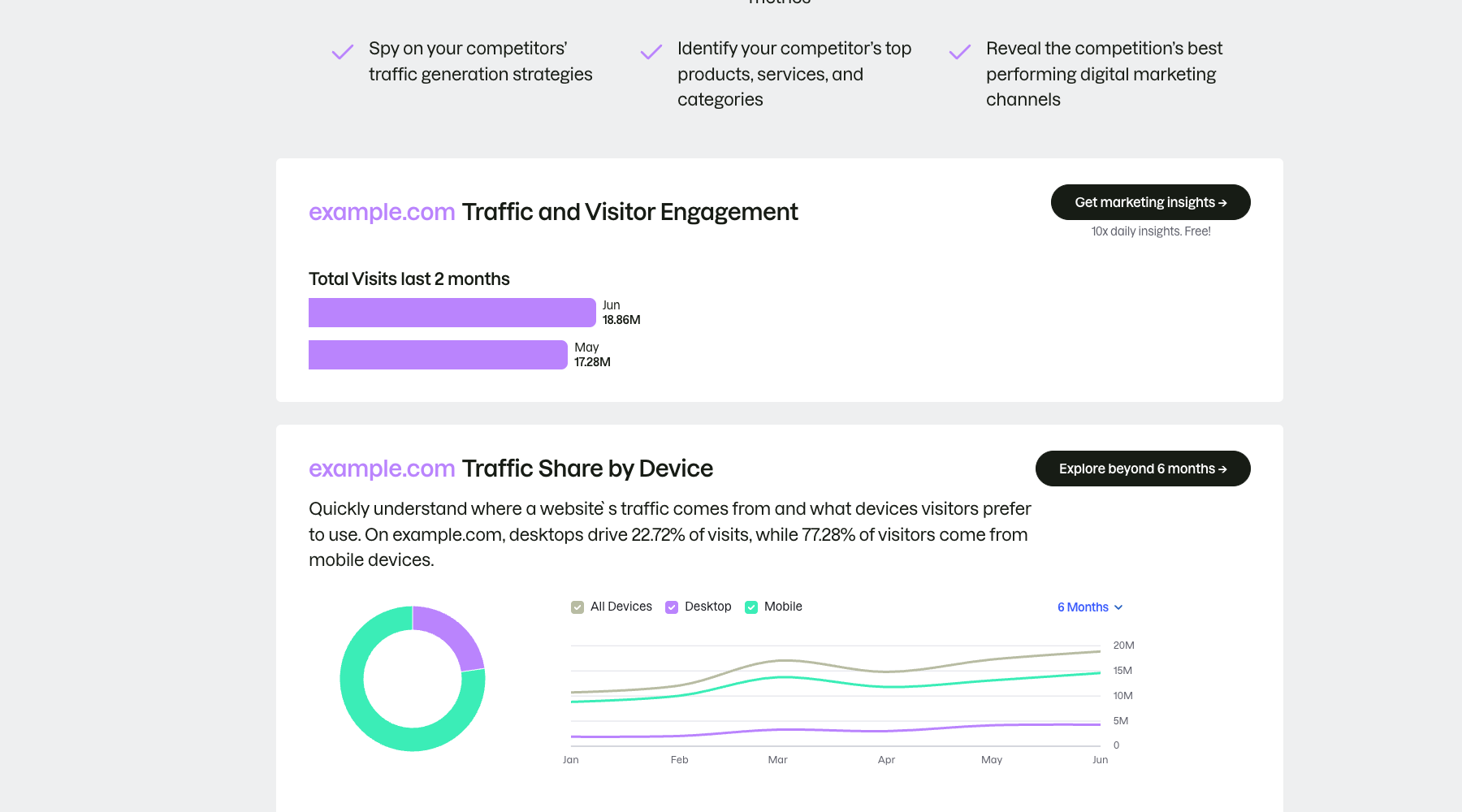
Focuses on total visits, visit duration, bounce rate, channels, audience, and market share. It belongs to a different toolkit from SEO Toolkit and functions more like Similarweb; verify whether your target plan includes it before purchase.

Keyword Strategy Builder

Clusters keywords into topics and pages to help build pillar pages, subtopics, and content structure. Clustering results are a starting point and still require manual review of search intent and SERP.

SEO Writing Assistant

Provides readability, SEO, originality, and tone suggestions based on target keywords and competing pages. It suits the editing stage and should not replace expert fact-checking and brand voice.

Topic Research

Generates related subtopics, headlines, and questions based on a topic for content ideation. Some features mentioned in older reference articles, such as Post Tracking, may have been adjusted or migrated—refer to the current Content toolkit.

On Page SEO Checker

Compares your pages with ranking competitors and provides semantic, content, backlink, technical, and UX suggestions. Only process suggestions relevant to page goals and supported by evidence.

AI Visibility

Tracks brand mentions, citation sources, question topics, and competitive performance in generative search. AI search optimization should still be built on crawlable websites, reliable content, clear entity information, and traditional SEO foundations.

Semrush Plans & Pricing

Semrush's product bundles, prices, and add-ons change frequently. Below are the main plans shown on the official SEO Classic page as of July 2026; actual billing is subject to theofficial pricing page.

Plan Annual equivalent/month Monthly price Best for Main limits
Pro US$117.33 US$139 Individuals, freelancers, small projects 5 tracked websites, 500 tracked keywords
Guru US$208.33 US$249 Small businesses, growing teams, and agencies 15 tracked websites, 1,500 tracked keywords
Business US$416.66 US$499 Mid-to-large enterprises and established agencies 40 tracked websites, 5,000 tracked keywords

Key Differences Between Plans

  • Pro: keyword research, competitive analysis, rank tracking, backlink analysis, and site audit;
  • Guru: adds historical data, multi-location and device tracking, content optimization tools, etc.;
  • Business: adds Share of Voice, higher limits, API, and migration support.

Typical crawl limits listed in the official knowledge base: Pro 100K pages/month, Guru 300K pages/month, Business 1M pages/month. Report results, daily queries, exports, and metric refreshes also have respective limits.

What a Free Account Can Do

Free accounts typically allow limited domain and keyword queries and partial tool access, but daily requests, report results, and project capabilities are restricted. Suitable for evaluating the interface, not for ongoing management of multiple websites.

Semrush official pages may offer a 7-day trial. Before starting, confirm:

  • Which toolkit the trial corresponds to;
  • The automatic renewal price after the trial ends;
  • Whether additional purchases of Traffic & Market, Local, Content and other toolkits are needed;
  • Whether keywords, projects, user seats and export limits meet requirements.

Differences between Semrush and other tools

Tool Strongest Use Case Best For
Semrush Keywords, competitive SEO, site audit, rank tracking and multi-channel marketing SEO and marketing teams needing complete workflow execution
Similarweb Omni-channel traffic, market share, audience and industry trends Strategy, market research and growth teams
Ahrefs Keywords, content exploration and backlink research SEO, content and link building teams
Google Search Console Google impressions, clicks, indexing and issues for your own website All website owners
Google Analytics 4 User behavior, events and conversions for your own website Product, operations and data teams

Semrush vs Similarweb

Similarweb emphasizes overall website traffic and market landscape; Semrush emphasizes search marketing and execution. Similarweb is more intuitive when researching "who is growing in the entire industry"; Semrush is more complete when researching "what to write, what to fix, and what to track".

Semrush vs Ahrefs

Both can complete keyword and backlink research. Ahrefs' product experience is more focused on search and links; Semrush covers more modules including site audit, advertising, content, local, social and AI visibility. The choice should depend on the team's actual workflow, not simply comparing database sizes.

Semrush vs Search Console

Search Console shows real Google search data for your own website; Semrush can research competitors and perform cross-country, keyword and tool comparisons. The best practice: use Semrush to discover opportunities, use Search Console to validate your website's real performance.

Pros, Limitations and Common Misconceptions

Pros

  • Complete feature coverage, connecting research, execution and monitoring;
  • Strong competitor keyword and page research capabilities;
  • Keyword intent, gap and clustering tools suitable for content planning;
  • Site audit and rank tracking suitable for ongoing project management;
  • Backlink analysis, gap and building tools form a workflow;
  • Supports multi-country databases and Simplified Chinese interface;
  • Reporting, export, API and third-party integrations suitable for team collaboration;
  • AI search visibility capabilities have been added.

Limitations

  • Many features, higher learning curve for beginners;
  • Competitor traffic and keyword clicks are estimates;
  • Plans and add-on tools are complex, overall cost may be high;
  • Data coverage for specific markets like mainland China and Google ecosystem requirements need separate evaluation;
  • Different tools have different metric definitions, cannot be simply added together;
  • Automated suggestions do not equal correct strategy, still requires human judgment of business and search intent;
  • Crawling, reporting and export limits for large websites may require advanced plans.

Common Misconceptions

Only looking at keyword search volume

High search volume doesn't mean suitability. Should also look at intent, difficulty, SERP, business value and website strength.

Copying all competitor keywords

Competitor brand terms, old business and low-conversion content may not suit you. The goal of competitive analysis is to understand strategy, not mechanical copying.

Treating authority score as a Google metric

Authority Score is a third-party metric by Semrush. It is suitable for comparison and filtering, not proof of Google's ranking factors.

Pursuing a 100-point site health score

Prioritize fixing issues that affect crawling, indexing, important pages, and user experience. Notifications without business impact do not need priority.

Rejecting backlinks upon seeing "Risky"

Automated risk labels may misjudge. Rejecting links is a high-risk operation requiring manual review and confirmation of real issues.

Modifying pages daily due to ranking fluctuations

Rankings have normal fluctuations. Use weekly and monthly trends, combined with algorithm, competitor, and page changes for judgment.

30-Day Action Plan

Week 1: Establish Baseline

  • Connect GA4 and Search Console;
  • Create project;
  • Run first site audit;
  • Export current errors, warnings, and health score;
  • Add 3—5 core competitors;
  • Set up rank tracking for 20—50 priority keywords.

Week 2: Research Opportunities

  • Research competitors using Domain Overview and Organic Rankings;
  • Filter "Missing" and "Weak" using Keyword Gap;
  • Confirm intent and difficulty using Keyword Overview;
  • Expand long-tail and question keywords using Keyword Magic Tool;
  • Build keyword groups and page mapping.

Week 3: Execute Optimization

  • Fix technical issues affecting crawling and indexing;
  • Update old pages close to first page;
  • Create new content for missing topics;
  • Improve titles, structure, evidence, and internal links;
  • Build outreach list using Backlink Gap.

Week 4: Review

  • Re-run site audit;
  • Check ranking visibility and URL changes;
  • Compare real clicks and impressions from Search Console;
  • Document new content, fixes, and backlink actions;
  • Determine 5—10 priorities for next month.

Monthly Report Template

Dimension This Month's Metric MoM Change Cause Analysis Next Month's Action
Organic search clicks
Non-brand visibility
Top 10 keywords
Site health score
Critical technical errors
New referring domains
Published/updated pages

FAQ

Does Semrush have a Simplified Chinese interface

Yes. Interface language can be switched, but database and search location still need to be selected separately in each report.

Is Semrush data accurate

Your own website's GA4, Search Console, and server data are closer to real values. Semrush's competitive intelligence data is suitable for comparison, trend discovery, and opportunity research, not as precise backend data for competitors.

Can Semrush replace Search Console and GA4

No. Search Console and GA4 are first-party data for your own website; Semrush provides competitive research, keyword database, audit, and rank tracking. All three should be used together.

Which tool should beginners learn first

Recommended order: Domain Overview → Keyword Overview → Keyword Magic Tool → Keyword Gap → Site Audit → Position Tracking. After mastering these six, then learn backlinks, content optimization, advertising, and AI visibility.

What keyword difficulty is suitable

There is no universal number. New websites should start with highly relevant, clear-intent, lower-difficulty long-tail keywords; authoritative websites can compete for higher-difficulty topics. Personalized keyword difficulty is more valuable than generic KD.

Is Semrush suitable for Chinese SEO

It supports Chinese interface and partial Chinese market databases, but you should test keyword coverage for your target region and industry before use. When targeting Baidu, Xiaohongshu, WeChat, or other non-Google ecosystems, you need to combine with corresponding platform data tools.

When should you purchase Guru or Business

Upgrade to higher-tier plans when you need historical data, multi-region/multi-device tracking, content optimization, higher report limits, Share of Voice, or API. Individuals and single small projects can usually start with Pro.

Summary

Semrush's value lies not in displaying more numbers, but in connecting SEO work into a closed loop:

Research competitors → Discover keywords → Plan pages → Fix technical issues
→ Build backlinks → Track rankings → Review with real data

For teams just starting out, the most important thing is not using all tools at once, but first establishing a sustainable process: regularly research competitors each month, select a few opportunities, execute optimizations, and review results.

Use Semrush to discover direction, use Search Console and GA4 to validate results, then use business revenue and conversions to determine next resource allocation.


References

This article is original content, referencing the information architecture of target articles, and rewritten based on Semrush's 2026 official navigation, knowledge base, and pricing pages. Operational screenshots are original Simplified Chinese interface mockups based on current features; values are for illustrative purposes only and do not represent real-time reports or official Semrush screenshots.

Further Reading and Next Steps

Sources and Verification Notes

This article was reviewed by the RelayX Editorial Team on August 24, 2026 based on the following official sources. Product features, limits, and prices may change; when making purchase decisions, please verify again on official pages and RelayX's real-time product pages.